Industrial components, fast chargers, adapters, and grid stabilization units optimized for global compliance.
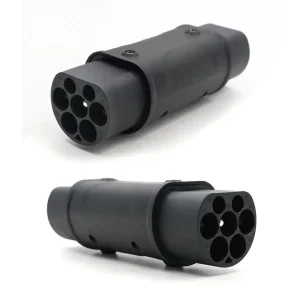
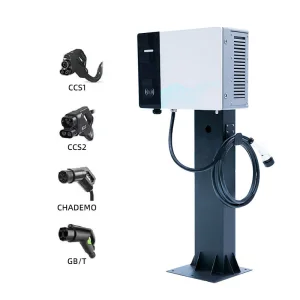
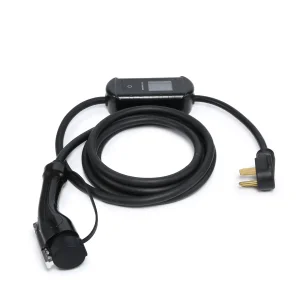
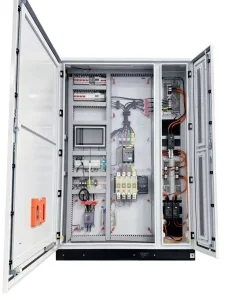
An authoritative analysis of hardware integration, OCPP implementations, and grid management telemetry for Charge Point Operators (CPOs) and fleet administrators.
In the transition to massive electrification, electric vehicle (EV) charging hardware cannot function as isolated entities. High-capacity charging grids require real-time telemetry, predictive diagnostic networks, and highly optimized control interfaces to guarantee continuous uptime. A modern EV charging monitoring solution consists of an integrated architecture of microprocessor controllers, communication gateways, and cloud software engines.
From dynamic load management (DLM) at the local distribution tier to cloud-based diagnostic applications, modern EVSE (Electric Vehicle Supply Equipment) networks leverage communication standards such as OCPP 1.6J and the newly evolved OCPP 2.0.1 (JSON over WebSockets). These protocols facilitate seamless transactions, user authorization, temperature safety thresholds, and voltage regulation mechanisms. This document evaluates the operational paradigms, supply chain factors, and critical engineering metrics that global procurement departments prioritize when sourcing charging systems from specialized OEM/ODM factories.
Real-time algorithmic distribution of power across multiple charging terminals prevents local grid overload and decreases site power installation costs.
Native integration of the Open Charge Point Protocol ensures hardware cross-compatibility and secure payment transactions with international backends.
Continuous monitoring of internal cabin heat, power conversion efficiency, leakage current, and system component degradation to support proactive maintenance.
Hangzhou Volt Charger Co., Ltd. is a leading innovator in the electric vehicle (EV) charging industry, specializing in Portable & DC EV Chargers, EV Charging Adapters, and Smart Energy Solutions. Established in Hangzhou, China, the company has rapidly gained a reputation for delivering high-quality, reliable, and technologically advanced charging products that meet the evolving demands of EV owners and businesses worldwide.
With a commitment to sustainability and innovation, Hangzhou Volt Charger integrates cutting-edge technology into its product portfolio, offering fast, efficient, and safe charging solutions suitable for home, workplace, and public applications. Its portable chargers provide convenience for EV users on the go, while its DC fast chargers ensure rapid energy replenishment for commercial fleets and public charging stations.
The company also develops intelligent charging adapters and energy management systems, enabling seamless connectivity, real-time monitoring, and optimized power usage. By combining robust hardware with smart software, Hangzhou Volt Charger empowers clients to reduce energy costs, enhance charging efficiency, and future-proof their EV infrastructure.
Serving global markets with an emphasis on quality, safety, and customer satisfaction, Hangzhou Volt Charger Co., Ltd. is dedicated to accelerating the adoption of electric mobility and supporting a greener, smarter, and more sustainable transportation ecosystem.

China's industrial landscape has become the global hub for EV infrastructure manufacturing. The reason is not merely low manufacturing labor cost, but rather a hyper-efficient technology ecosystem, comprehensive vertical integration, and extensive infrastructure scale.
The manufacturing cluster located in Zhejiang and Guangdong provinces houses critical component suppliers in close geographic proximity. From copper connectors and robust metal enclosure fabrication to advanced microprocessor and semiconductor assembly (PCBA), every element of an EVSE is sourced locally. This reduces transit times, minimizes logistics overhead, and protects the production process from external geopolitical supply shocks.
Our OEM/ODM engineering teams can turn a client's specification sheet into a fully functional prototype in weeks, compared to months in other regions. With proprietary testing labs capable of simulating high ambient temperatures, extreme humidity, electrical surges, and EMI (Electromagnetic Interference), design issues are identified and resolved before volume manufacturing begins.
By producing thousands of charging components every month, we can source raw materials at highly competitive rates. This cost advantage is passed directly to the buyer. At the same time, we offer customized options, allowing clients to specify custom brand colors, custom enclosure shapes, custom firmware configurations, and localized software interfaces.
As transportation transitions from fossil fuels to clean electricity, various commercial sectors require customized setups. Standard hardware configurations must be matched with tailored software architectures.
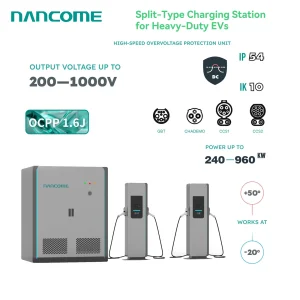
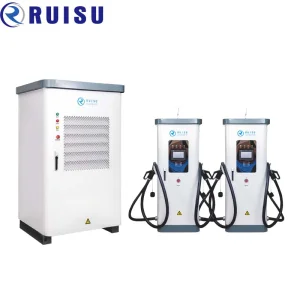
Commercial trucking and logistics fleets demand high power delivery coupled with systematic scheduling. A single depot might house dozens of 160kW to 240kW DC fast chargers. Without intelligent local monitoring, these chargers could overload the utility feeder. Our systems employ automated load balancing alongside peak-shaving techniques, utilizing localized battery storage enclosures to minimize demand charges.
For Charge Point Operators (CPOs), profitability depends on maximizing equipment uptime and ensuring smooth payment processing. Smart monitoring systems track charger availability in real time, alerting remote support to errors before customers encounter them. Furthermore, integrated support for credit card terminals, QR code payments, and mobile apps provides consumers with a smooth charging experience.
By combining distributed photovoltaic generation with large-scale industrial energy storage cabinets, enterprises can establish self-sufficient microgrids. This approach reduces overall energy costs and provides back-up power, protecting operations from grid outages.
Industrial procurement departments, municipal utilities, and corporate buyers evaluate potential OEM/ODM partners based on strict criteria. Our engineering processes are structured to meet these demanding requirements:
| Evaluation Parameter | Technical Standard / Requirement | Business Significance |
|---|---|---|
| Safety Certification | CE, TUV, ETL, FCC, RoHS, IEC 62196, UL 2202 | Guarantees access to European, American, and Asian markets. |
| Communication Protocol | OCPP 1.6J / OCPP 2.0.1 compliance, Modbus TCP | Ensures integration with third-party billing and network management systems. |
| Enclosure Protection | IP54 / IP55, IK10 Impact Resistance | Ensures reliable long-term operation in harsh outdoor conditions. |
| Cybersecurity | TLS 1.2/1.3, Encrypted Bootloader, ISO 27001 | Protects user payment data and local energy grid components from cyber threats. |
Technical clarifications concerning OEM/ODM customization, protocol capabilities, and hardware integration.
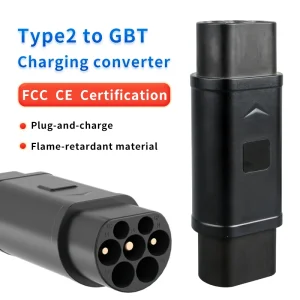
Explore our fast DC chargers, high-capacity energy storage systems, and specialized charging adapters.

 Volt Charger