Long-distance EV travel feels simple until the battery drops faster than expected. Hills, rain, cold weather, heavy luggage, and highway speeds can quietly reduce your driving range. A reliable plan must account for these details before the journey begins.
This guide explains How to plan long trips with EV charging stops using practical route planning, charger research, and realistic backup options. EV charging expert Tom Moloughney offers a useful reminder: “Charging should support the trip, not define it.” That idea matters when a five-minute detour prevents an hour of uncertainty.
Begin with your vehicle’s usable battery capacity, not its advertised range. Check charger speeds, operating hours, payment requirements, and recent reliability reports. A station with eight plugs may still create delays during holiday traffic. Look for restaurants, restrooms, or grocery stores nearby. A useful stop should serve the driver, too.
Leave a safety margin.
Do not plan every leg around the final few battery percentages. Arriving with 10% to 20% remaining can protect you from detours or broken equipment. Still, perfect planning is impossible. Some apps show outdated availability, and weather forecasts can change quickly. Recheck conditions before departure and during the drive.
The following seven strategies turn charging stops into manageable travel decisions. They also encourage honest reflection. Your fastest route may not be your easiest route. A slightly longer journey, with dependable chargers and comfortable breaks, often creates the better experience.
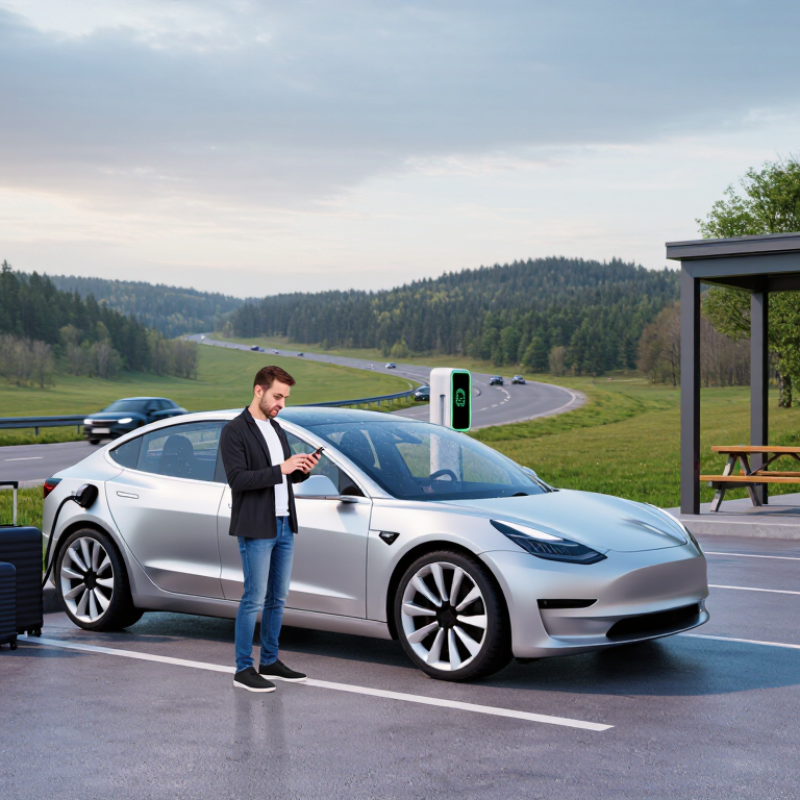
7 Best Ways to Plan Long Trips With EV Charging Stops
Define Your EV’s Range, Charging Speed, and Trip Requirements
Start with your EV’s usable battery capacity, not its advertised range. Weather, speed, hills, and cabin heating can reduce real-world distance. The U.S. Department of Energy notes that cold temperatures can significantly affect EV efficiency. Treat the dashboard estimate as guidance, not a promise. Leave a 15–20% battery buffer before reaching each charger. It feels cautious, but unexpected detours happen.
Charging speed matters as much as distance. A vehicle accepting 150 kW may charge quickly, while another may accept far less at the same station. The International Energy Agency reported more than 4 million public charging points worldwide by the end of 2023. Yet availability varies sharply between urban and rural routes. Check connector compatibility, charger power, opening hours, and recent reliability reports. A fast charger is useless if your vehicle cannot use its full output.
Tips: Build the route around charging time, not only mileage. Plan a meal or short walk during longer stops. Keep one backup charger within practical range. Avoid arriving nearly empty. That mistake is easy to make. Also compare your planned consumption with previous trips, because personal driving habits may reveal a less comfortable range. Public charging data can be incomplete, and route planners sometimes overestimate charger availability. Recheck the trip shortly before departure.
| Planning Method | What to Do | Important Data to Collect | Practical Benchmark or Calculation | Planning Result |
|---|---|---|---|---|
| 1. Define the Usable Driving Range | Start with the vehicle's real-world usable battery capacity and expected energy consumption instead of relying only on the published maximum range. | Usable battery capacity, estimated highway efficiency, passenger and cargo weight, road speed, elevation, and expected weather. | Many EVs use approximately 18–28 kWh per 100 km (29–45 kWh per 100 miles) during highway travel, but consumption varies considerably by vehicle and conditions. | Establish a realistic trip range and avoid planning every charging stop at the vehicle's maximum advertised range. |
| 2. Build a Conservative Range Buffer | Reserve energy for traffic, detours, strong headwinds, steep climbs, low temperatures, and limited access to the next charger. | Weather forecast, wind direction, road grade, traffic conditions, road closures, and the distance to the next reliable charging option. | A 10–20% energy buffer is a useful normal-trip starting point. In severe cold, mountainous terrain, or uncertain conditions, increase the buffer because energy use can rise substantially. | Set a minimum arrival state of charge, commonly around 10–20%, rather than arriving with almost no reserve. |
| 3. Match Stops to Charging Speed | Compare the vehicle's maximum AC and DC charging capability with the power available at each stop. The vehicle may accept less power than the charging station can provide. | Maximum vehicle charging power, connector compatibility, battery temperature, current state of charge, and station power rating. | AC charging commonly operates around 7–11 kW. DC fast charging may range from about 50 kW to more than 200 kW, but charging power usually decreases as the battery becomes fuller. | Choose the fastest suitable stop for the route, while avoiding unnecessary high-power charging when a shorter stop or destination charging is more practical. |
| 4. Plan Around the Charging Curve | Prefer shorter charging sessions during the battery's faster charging range instead of routinely charging to 100% during a road trip. | Vehicle charging curve, current battery percentage, target battery percentage, battery temperature, and the distance to the following stop. | Many EVs charge fastest at lower and medium states of charge, then slow noticeably as the battery approaches 70–80% or higher. The exact curve is vehicle-specific. | Use a typical road-trip target of approximately 70–80% when the next leg is short enough, and charge higher only when the route requires it. |
| 5. Calculate Each Leg Before Choosing a Stop | Convert each route segment into an energy requirement, then check whether the planned stop leaves enough energy for the next segment and a reserve. | Leg distance, estimated consumption, elevation changes, reserve percentage, starting state of charge, and planned charging target. | Estimated energy required = distance × consumption rate. For example, 240 km at 22 kWh per 100 km requires about 52.8 kWh before adding a reserve. | Produce a stop-by-stop energy plan instead of selecting charging locations only by equal distance intervals. |
| 6. Verify Availability and Add a Backup | Check live availability, operating status, access hours, payment requirements, connector type, parking rules, and nearby alternatives before departure. | Number of compatible connectors, current station status, expected travel time, local opening hours, and the distance to the next alternative. | A primary stop plus a backup within roughly 15–30 minutes of driving can reduce the risk caused by queues, faults, restricted access, or unexpected closures. | Create a resilient route with an alternative stop and enough battery reserve to reach it without excessive detouring. |
| 7. Combine Charging With Planned Breaks | Select stops near meals, restrooms, shopping, lodging, or overnight parking so that charging time supports the travel schedule rather than creating separate idle time. | Required break duration, charging time, accommodation facilities, destination charging availability, and the driver's preferred arrival time. | A DC fast-charge session may take roughly 20–40 minutes for a partial charge, but the actual time depends on the vehicle, battery temperature, starting state of charge, and station output. | Reduce perceived travel time, avoid unnecessary charging to 100%, and align energy planning with realistic driver-rest requirements. |
Map charging stations beyond major highways. Include city streets, rural roads, and mountain routes. Coverage can vary widely.
Check connector type, charging speed, opening hours, payment methods, and recent availability. Online listings can become outdated.
Yes. Select a primary station and a backup within practical range. Save both addresses offline before entering weak-signal areas.
Aim to reach unfamiliar stations with at least 15% battery remaining. Cold weather, steep roads, traffic, and roof loads reduce range.
A bay may be blocked, a cable may fail, or access may be limited. Maps are not proof.
Carry compatible cables, a tested portable charger, a flashlight, gloves, and basic tire equipment. Keep the charger dry.
No. Do not assume every outlet provides safe or useful charging. A qualified electrician should inspect a planned outlet.
Save two alternative locations along each major route. Carry food and water. Leave extra battery for delays and weather.
Treat live data as guidance, not a guarantee. Recheck availability before departure, but keep a practical backup plan.
Avoid scheduling too tightly around predictable traffic. I still make that mistake sometimes. Flexible arrival times reduce stress.
Planning a long electric vehicle journey requires more than simply entering a destination into a navigation app. How to plan long trips with EV charging stops begins with understanding your vehicle’s real-world driving range, charging speed, battery condition, passenger load, weather, and trip objectives. Use this information to divide the journey into practical driving segments, then identify dependable charging stations along the route. Consider station availability, operating hours, connector compatibility, charging capacity, nearby services, and expected traffic before choosing each stop. Estimate how long charging may take and allow extra time for busy periods or slower-than-expected sessions.
Before departure, review the complete route and confirm that each planned stop supports the next leg of the trip. Prepare suitable backup charging options, such as alternate stations or a flexible stopping point, in case of congestion, maintenance, detours, or unexpected energy use. It is also wise to begin with a sufficient battery level, monitor consumption while driving, and adjust the plan when conditions change. Careful preparation makes long-distance EV travel more predictable, comfortable, and efficient.

 Volt Charger